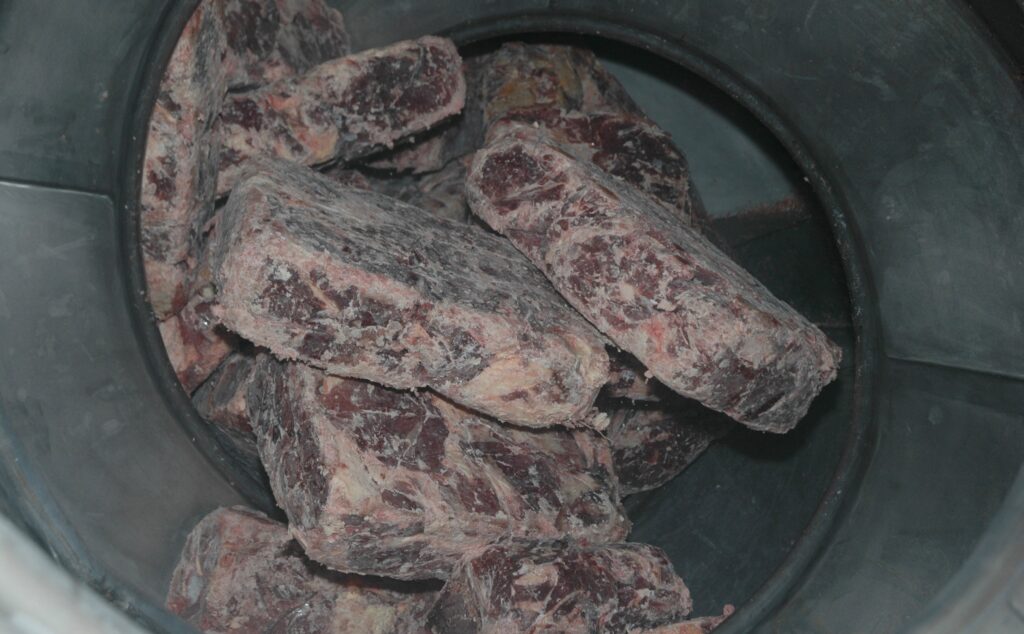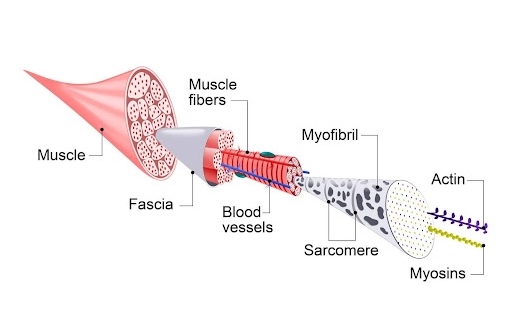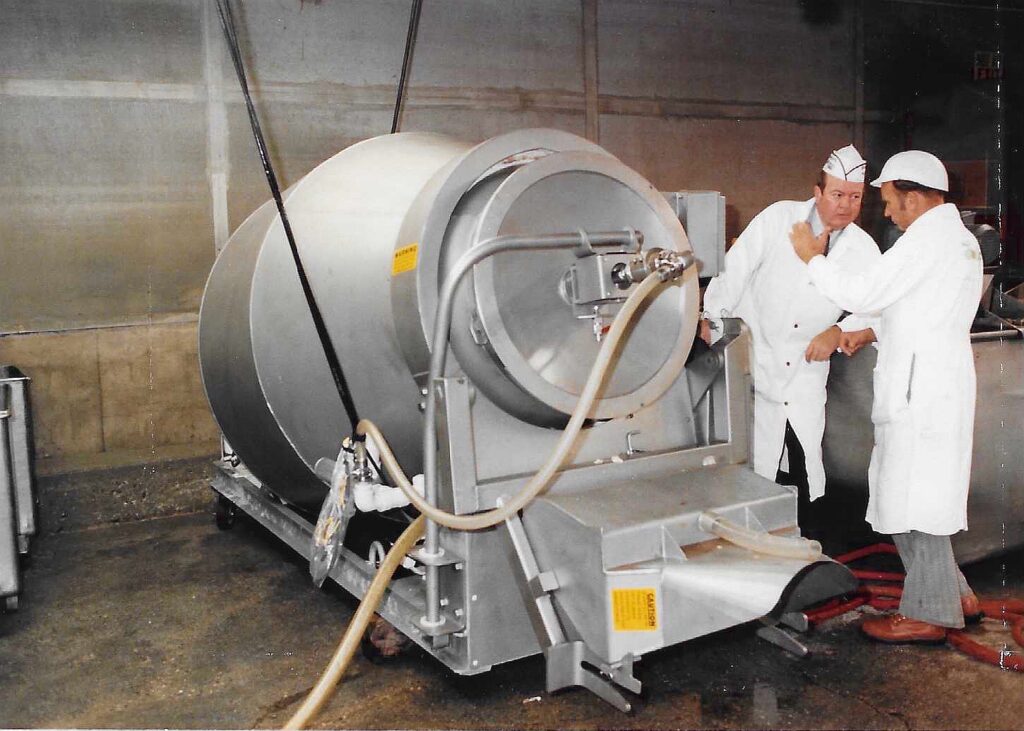
When Challenge RMF came on the scene in 1980, industrial tumbler marinater machinery treated whole muscle meat like Rocky Balboa treated sides of beef. Their machines pummeled, smashed, and dropped product in an attempt to force marinades into the muscles, even though the process degraded muscle integrity.
It wasn’t tenderizing; it was traumatizing.
These old-style generic tumblers created uneven meat textures, an unpleasant mouthfeel, lower overall quality, and yield loss due to pulverized tissues and unabsorbed marinade.
Challenge RMF reinvented meat processing machinery, using our advanced Meat-on-Meat Massage™ technology in every massager/marinater, cryogenic marinater, and microwave thawing system.
We set a new standard of excellence that processors still rely on today
Contact us, and let’s talk about your processing plant needs. We’ve been in the business for decades, and we speak fluent meat. Plus, read on to understand how other tumblers stack up against our meat massager/marinater.
It’s a “challenge” we gladly accept.
Get to the Meat of the Matter
- The truth about tumblers
- Why Challenge RMF technology is better
- What makes Challenge RMF different
- Our simplified purchasing process
- FAQs about massager/marinaters
Don’t Confuse “Cheap” With “A Good Deal”
Most traditional vacuum tumblers are designed to minimize manufacturing cost—not to maximize processor performance, yield, or longevity.
As a result, most old-style industrial tumbler marinater systems rely on one of three internal configurations for moving product inside the drum—each with built-in limitations that impact product quality, consistency, and long-term reliability.
The Drawbacks of Straight Flights
Welded to the drum, long, straight flights act like rotating shelves. They constantly lift smaller amounts of product and drop it to the bottom of the barrel causing hydraulic shock. This causes impact damage to meat fibers, supposedly tenderizing each piece while forcing marinade/brine to penetrate for increased yield.
In reality, it mostly beats up the outer muscle tissues, emulsifying the exterior while delivering no tenderization to the core. This creates that inconsistent bite quality and lack of even flavor dispersion. The hydraulic shock also reduces moisture-binding capacity, resulting in lower yield.
As if the effects on the product quality aren’t worrisome enough, hydraulic shock action in a traditional industrial tumbler marinater causes extra stress to the straight flights in vacuum tumblers, weakening their welds. That forms cracks, increasing the risk of contamination, and leading to more frequent repairs.
The only benefit of straight flights is for the manufacturer: they allow the manufacturer to build their machine more cheaply and more easily, with simpler fitting and welding.
The Drawbacks of Internal Paddles
In this tumbler design from the mid-20th century, the drum remains stationary while a central axis rotates a series of blunt-edged metal blades inside it. Meat flops around the blades, sometimes catching in the spaces between the blades and the drum wall and shearing.
Because the paddles are affixed to the central axis on welded “arms,” these meat tumblers run smaller to reduce stress on the machine. Where Challenge RMF meat massager/marinater capacities range from 2,500 lb. (1,250 kg.) all the way up to 22,000 lb.(10,000 kg.), the capacity for an industrial tumbler marinater with an internal paddle system generally ranges from 220 lb. (100 kg) to 15,000 lb. (6,800 kg).
The biggest downside: this design can tear and smear muscles, break bones, peel skin, and increase loss through product damage. These machines are just well-marketed vacuum mixers, not massager/marinaters.
The Drawbacks of “Wave Shelf” Flights
In this industrial tumbler marinater design, a single flight curves out from the drum wall in a cresting “wave shelf” shape. This version provides a gentler action than the flat flight, lifting the product and letting it slide over the edge before falling back into the drum. Product then waits in the bottom of the drum until the drum rotates fully to lift the mass again.
Though less destructive than the other two, this slower form of tenderizing and marinating doesn’t match today’s throughput needs or preferred quality standards.

Up for the Challenge: Better Design for Maximum ROI
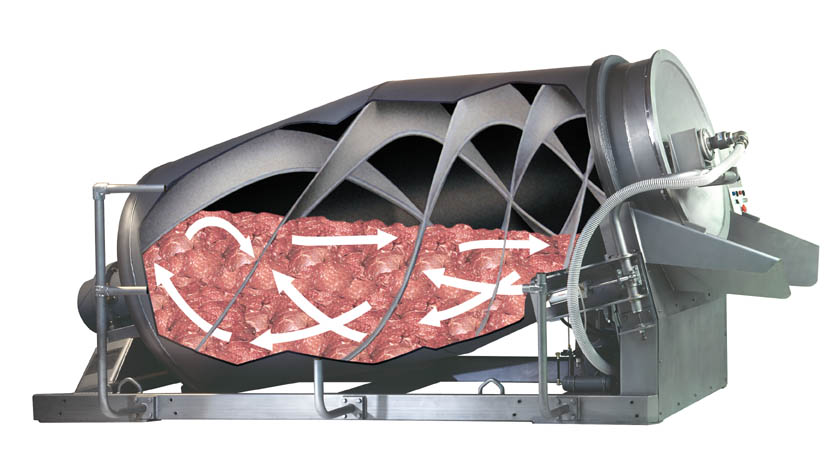
Inside a Challenge RMF massager/marinater, unique Meat-on-Meat Massage™ action moves, folds, and massages the meat using our custom-fabricated helical flights.
As the drum rotates, the sheer weight of the contents bears down on the muscles at the bottom of the drum. As it turns, the helical flights lift the bottom muscles to the top, relieving that pressure.
This rhythmic “rolling” action mimics the effect of repeatedly stretching a rubber band. It systematically works the connective tissue fibers, tenderizing completely without compromising the muscle’s physical structure.
The Unique Effect of Meat-on-Meat Massage™ Technology
Meat-on-Meat Massage™ delivers continuous compression and relaxation. By the end of the cycle, the connective tissues have transformed—becoming delicate and tender—while the muscle matrix remains intact. The meat stays whole rather than being shattered or ruptured.
Bypassing and outperforming hydraulic shock and shearing paddle action, our design carefully tenderizes the tissue all the way through to the core of the muscles. The massager also activates intracellular proteins for molecular-level water binding, improving both product quality and batch yield.
Built to Play the Long Game
The Challenge RMF version of an “industrial tumbler marinater“ costs more than the cheaper alternative versions.
That’s because we didn’t take the low-cost route. We chose the better road, the high-quality road, and that has made all the difference. Challenge RMF designs for 20+ years of continuous operation – not for short-term competition.
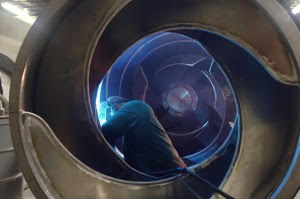
Through superior structural engineering and a “take no prisoners” quality-control process, every component gets inspected, then inspected again, then tested and inspected.
No shortcuts, no compromises—we give our clients nothing less than superior, quality manufacturing backed up by top-tier customer service.
In other words, it costs more because it’s worth more. But let’s let the facts do the talking.
Construction
- Stainless steel drums. We construct our drums out of 5mm to 7mm thick stainless steel plates to ensure rigidity and longevity.
- Stainless steel flights. You can choose from 2-flight or 4-flight models. In both cases, the hand-welded stainless steel flights also reinforce the drum, making it stronger, more durable, and longer-lasting. Much longer-lasting. In fact, our very first model, sold in 1980, is still in use today.
- Advanced welding and polishing. All seams at the circumference of the drum are submerged-arc welded. The flights are hand-welded and polished to approved food safety standards.
- Powerful support system. We create the drum track from 50mm x 75mm stainless steel. The entire substructure and the framing inspire confidence through outstanding craftsmanship and quality materials.
- Efficient Footprint. Our massager/marinater units require up to 50% less floor space than almost any other industrial tumbler marinater of comparable batch capacity.
- Safety-dominated drum opening. We reinforce the drum opening with 25mm x 50mm stainless steel and a 6mm x 125mm band welded to the discharge cone.
Components
- A powerful, protective vacuum pump. The massager/marinater water-ring vacuum pump passes meat and brine without contaminants that would otherwise interrupt production.
- Simple, heavy-duty drive systems. We offer your choice of rugged electric or hydraulic drives to fit your goals. Both include a zero-slip gear reducer with heavy-duty bearings for cleaner, low-maintenance operation and relentless performance.
- Door-fed vacuum loading. Vacuum loading through the door allows you to transport whole-muscle meats into the massager/marinater without stopping the cycle or breaking the vacuum. You save cycle time and product quality.
- Available tilt frame. Processing facilities often choose this option so that the drum can tilt forward for unloading.
- Infinitely variable drum RPM. Via your choice of Standard, PLC, or PC controls, you can access infinitely variable RPMs for precise rotation that minimizes loss and maximizes yield.
Superior Support
We keep a significant parts inventory on hand that we can ship overnight. You can reach our support team of engineers and product specialists quickly via phone and e-mail, and they can arrive on-site as soon as possible to help.
Our support can also include installation and start-up, all grounded in decades of experience involving a vast number of products and production situations across multiple countries and continents.
Challenge RMF’s craftsmanship, backed by our materials and component choices, requires the least amount of routine maintenance in an industry known for abusing equipment. In fact, our machines generally deliver an astounding 99% uptime!
American-Made Value
We don’t just “assemble” our systems in the United States, nor do we import them from other countries as an industrial tumbler marinater distributor.
We custom-design each system here. We weld the parts here. We fabricate important components in-house through our partnership with RMF Steel.
And our team holds every part and unit to higher standards and tighter tolerances than imports, keeping your facility safe from the detrimental impact of poor craftsmanship or supply chain issues.
The Challenge RMF Difference
When considering an industrial tumbler marinater from one of the “other guys,” be sure to check out these differences along with the price:
- If the vacuum tumbler relies on hydraulic shock, it reduces product quality and limits the machine’s flexibility. Hydraulic shock tumblers break bones, tear skin, and don’t handle high-value meats or seafood well.
- Tumbler-style machines focus most of their energy on the muscle surface. The Challenge RMF massager/marinater action tenderizes the entire muscle at once.
- Though some competitors try to copy our helical flight technology, they don’t maximize interior capacity. They often use a straight horizontal axis, whereas Challenge RMF builds ours on an inclined axis, providing more massaging action even as the batch sizes increase.
- Other industrial meat tumblers reduce the cohesion of whole muscles, often requiring the expense of additional binding ingredients. This adds to batch cost, and their stickiness can cause uneven brine distribution.
- Other industrial tumbler marinater units come with a smaller door. This design flaw makes it hard to get product in and out of the drum.
- Many commercial meat tumblers make cleaning more difficult and time-consuming. Challenge RMF’s design offers simpler and faster cleaning and sanitizing, reducing downtime and maintenance staff overhead.
Why Pay for Better Quality?
Product throughput abuses the equipment 24/7/365. It has to stand up.
We’re happy to talk with you about the positives and negatives of any piece of our equipment. Just understand that we firmly believe the bottom line is your bottom line. We work as your vendor and your partner, so you can maximize your investment for long-term growth.
In the end, Challenge RMF massager/marinaters deliver superior results at a lower life-cycle cost. That’s a bottom line everyone can live with.
The Challenge RMF Purchasing Process
We also believe your time is valuable during the planning phase. That’s why we streamlined our purchasing process, so that you can get the facts, make decisions, and start production of your bespoke Challenge RMF massager/marinater.
Step 1: Discussing the Project
Call us or contact us, and let’s talk about your goals. We want to answer all your questions and understand your situation fully before making any recommendations.
Step 2: Creating a Quote
Once we have the necessary facts and figures, we prepare a professional quote that takes everything into account. You’ll know what your investment looks like from fabrication of the equipment all the way through start-up and support.
You also have the chance to make adjustments before we start. Typical lead times are discussed upfront so you can plan production schedules with confidence.
Step 3: Purchasing Your Massager/Marinater
Now that you’ve signed on, we become partners. You’ll approve drawings and get updates as we manufacture your investment.
Step 4: Shipping, Installation, and Start-Up.
We ship your equipment to your location, and our installation team goes to work fitting it in and helping your facility with start-up.
Step 5: Using It. A Lot.
Put your new Challenge RMF equipment to work to improve your product quality and plant throughput.
FAQs About Challenge RMF Marinaters/Massagers
As you research options for a suitable industrial tumbler marinater, you’ll have questions. These are some of the more common ones we field during this phase of the purchasing process.
Can these units be integrated with automated loading/unloading and conveyor systems?
Yes, Challenge RMF massager/marinater units can be integrated with automated loading/unloading equipment and with conveyor systems. Our available tilt frame, along with our PLC and PC controls, lets you optimize the unit’s functions as you integrate it into your current processing line.
We also offer processing line equipment custom-designed to increase throughput while decreasing product loss and contamination points. This equipment includes:
- Massager/Marinater Vat Dumper. This includes our pallet drop feature to keep pallets from being over product, which reduces contamination risk.
- Massager/Marinater Cart Dumper. A liquid retention chute increases yield by decreasing drip loss.
- Vacuum Loader. One system can load multiple massagers, with customizable hose/pipe diameters for a large range of product sizes.
- Microwave Thawing System. The revolutionary Challenge RMF Microwave Thawing System delivers dramatically shorter thawing times with zero product loss due to drippage.
- Cryogenic Marinater. We custom-manufacture each unit to your spec choices, including your size preference and selected accessories.
How does the equipment handle high-volume “back-to-back” cycles without mechanical fatigue?
We designed Challenge RMF’s entire line of products to handle high-volume “back-to-back cycles with the least mechanical fatigue.
We use in-house, precision-engineered major components for maximum durability:
- Custom-built hydraulics
- Expert welding and polishing
- Helical flights that increase structural integrity
For a real-world example of our longevity over the traditional industrial tumbler marinater, our very first model, sold in 1980, is still in use today.
How does Challenge RMF’s sanitary design minimize harborage points for Listeria and Salmonella in high-volume environments?
The sanitary design built into a Challenge RMF massager/marinater minimizes harborage points—the minuscule crevices or dead zones where bacteria can hide and multiply—even in high-volume environments.
3 specific factors help to achieve this mandatory ability:
- Continuous helical flights. Challenge RMF’s Meat-on-Meat Massage™ technology uses helical flights continuously welded to the drum wall. This leaves no gaps or sharp angles where brine and organic matter can collect.
- Smooth surface topography. We polish the internal and external stainless steel surfaces to a high finish. This eliminates pits, cracks, and rough edges and prevents sanitizer-resistant biofilm formation.
- Self-draining geometry. We specifically designed the drum and frame so that liquids don’t pool or condense, reducing environments conducive to Listeria and Salmonella growth.
Are replacement parts and field service technicians available for 24/7 facility support?
Absolutely, our field service technicians can help schedule maintenance and other services for the time you need it. Our responsive customer service team supports you throughout your project’s entire lifespan.
Our top-quality parts department keeps necessary parts available, shelf-ready, so you can repair your system quickly and accurately. And our ability to custom-manufacture major components helps keep your production line’s downtime to a minimum during maintenance and repair.
Experience Quality in Motion
If you’re evaluating an industrial tumbler marinater for long-term performance, yield, and reliability, contact us. We’ll help you determine the right configuration for your process, product, and growth plans. You can also give us a call, or simply request a quote online.
Discover Challenge RMF’s full range of solutions for your whole-muscle processing and more. We’ve got engineering science—and decades of client satisfaction—to show you why our Meat-on-Meat Massage™ technology is the best in the business, for your business.